
Adaptive Localization

Self-calibrating hidden-target seeking from unknown-pose range-bearing relays.

This research studies hidden-target localization when the robot cannot directly sense the target and must use range-bearing packets from relays whose global position and yaw are unknown. The research comprises an ACC submission on trajectory-induced self-calibration and a CDC submission on excitation-supervised closed-loop target seeking.

Basic Idea

Motion turns uncalibrated relay sensing into usable target localization.

A robot receives local-frame range-bearing measurements from a relay, but the relay pose and yaw are not globally calibrated. From a single static viewpoint, target position, relay translation, and relay orientation share a continuous ambiguity. As the robot moves, distinct relative observations add constraints that remove this self-calibration ambiguity and anchor the hidden target.
Closed-Loop Layer

Excitation supervision decides when to explore and when to seek.

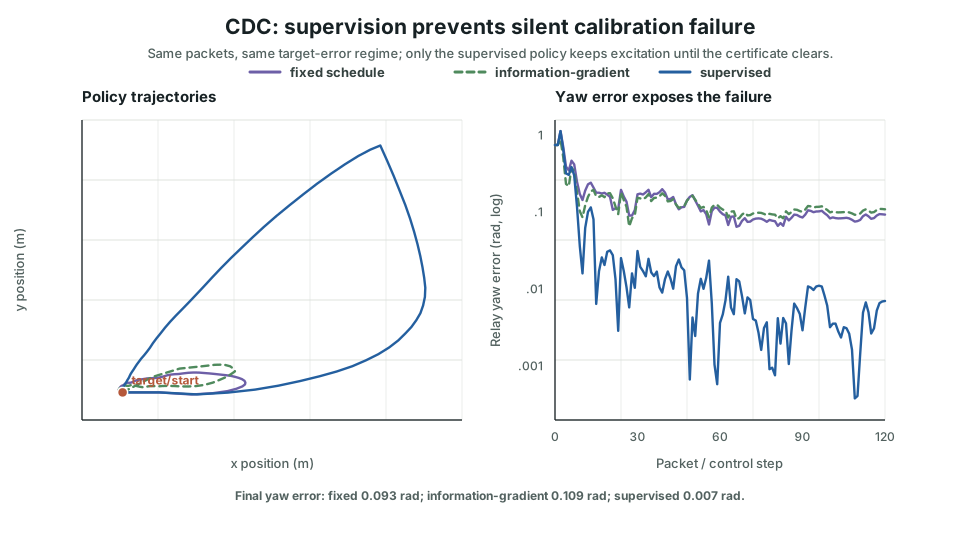
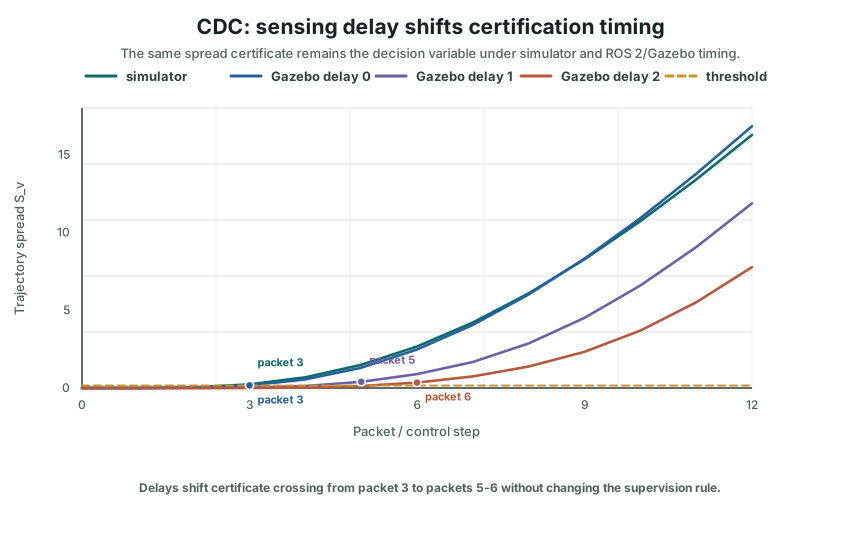
The closed-loop formulation uses a trajectory-spread certificate to decide whether the robot has generated enough excitation for reliable calibration. If the certificate is weak, the controller retriggers exploratory motion; once calibration is strong enough, it transitions to target seeking using the evolving hidden-target estimate.

Closed-loop Replay

Robot trajectory and target estimate converge from cooperative measurements.

The animation shows the first 50 steps of a two-relay local-frame project run. The robot starts with a coarse target estimate, uses range-bearing measurements from unknown-pose relays, updates the target and relay estimates, and moves toward the hidden target as the estimation error drops.

ACC Results

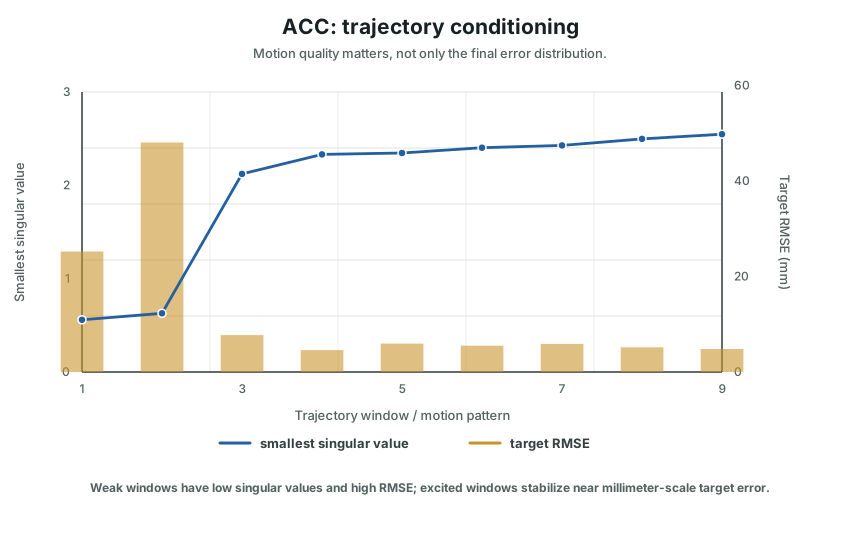
Self-calibration is governed by motion-induced trajectory spread.

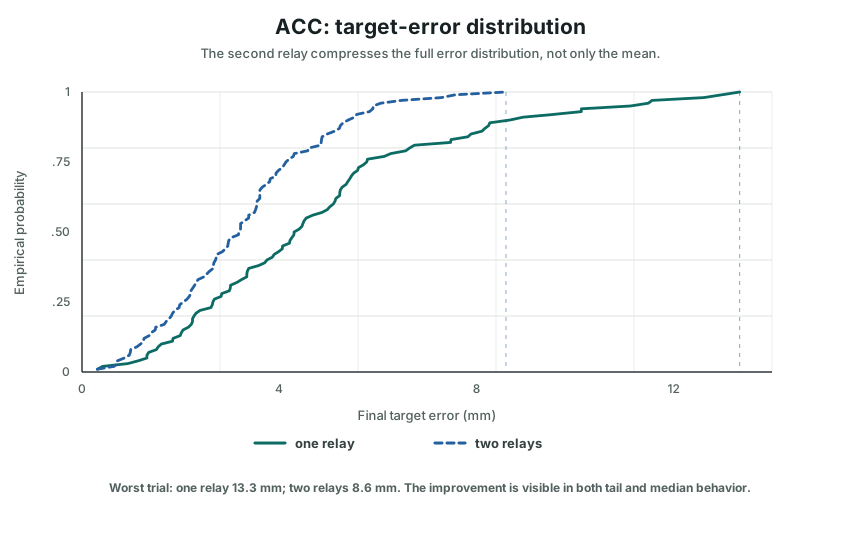
The ACC submission formalizes the minimum-motion effect: a single static vehicle pose leaves a rank-deficient one-relay model, while two distinct vehicle-relative observations can recover relay yaw, relay position, and the anchored hidden target in the noiseless case. The reported Monte Carlo studies connect this result to finite-noise estimation, outlier robustness, dropout, initialization error, and one-versus-two-relay behavior.

  • 1 pose: rank 4, singular value 0
  • 2 poses: rank 5, singular value 12.42
  • 80 poses: rank 5, singular value 91.80
  • Nominal target RMSE: about 5.5 mm in the one-relay Monte Carlo setting
CDC Results

Closed-loop supervision protects calibration when excitation would otherwise decay.

The CDC submission places the estimator inside a target-seeking loop. In the paired decay-rate sweep, the fixed baseline's yaw RMSE rises from 0.010 to 0.065 rad and success falls to 56%, while the supervised loop keeps yaw RMSE between 0.0095 and 0.0191 rad with 100% success. ROS 2/Gazebo software-in-the-loop traces test the same supervision logic with physics integration and sensing delay.